Collisions
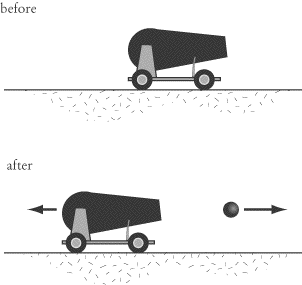
A collision occurs when two or more objects hit each other. When objects collide, each object feels a force for a short amount of time. This force imparts an impulse, or changes the momentum of each of the colliding objects. But if the system of particles is isolated, we know that momentum is conserved. Therefore, while the momentum of each individual particle involved in the collision changes, the total momentum of the system remains constant.
The procedure for analyzing a collision depends on whether the process is elastic or inelastic. Kinetic energy is conserved in elastic collisions, whereas kinetic energy is converted into other forms of energy during an inelastic collision. In both types of collisions, momentum is conserved.
Elastic Collisions
Anyone who plays pool has observed elastic collisions. In fact, perhaps you’d better head over to the pool hall right now and start studying! Some kinetic energy is converted into sound energy when pool balls collide—otherwise, the collision would be silent—and a very small amount of kinetic energy is lost to friction. However, the dissipated energy is such a small fraction of the ball’s kinetic energy that we can treat the collision as elastic.
Equations for Kinetic Energy and Linear Momentum
Let’s examine an elastic collision between two particles of mass  and
and  , respectively. Assume that the collision is head-on, so we are dealing with only one dimension—you are unlikely to find two-dimensional collisions of any complexity on SAT II Physics. The velocities of the particles before the elastic collision are
  and
and  , respectively. The velocities of the particles after the elastic collision are
  and
and  . Applying the law of conservation of kinetic energy, we find:
and , respectively. Assume that the collision is head-on, so we are dealing with only one dimension—you are unlikely to find two-dimensional collisions of any complexity on SAT II Physics. The velocities of the particles before the elastic collision are and , respectively. The velocities of the particles after the elastic collision are and . Applying the law of conservation of kinetic energy, we find:
Applying the law of conservation of linear momentum:

These two equations put together will help you solve any problem involving elastic collisions. Usually, you will be given quantities for  ,
,  ,
,  and
and  , and can then manipulate the two equations to solve for
  and
and  .
.
, , and , and can then manipulate the two equations to solve for and .Example
| ||||||
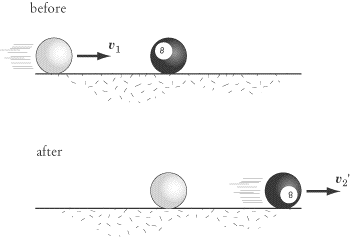
 . What are the velocities of the two balls after the collision? Assume the collision is perfectly elastic.
Substituting  and
and  into the equation for conservation of kinetic energy we find:
and into the equation for conservation of kinetic energy we find:
Applying the same substitutions to the equation for conservation of momentum, we find:

If we square this second equation, we get:

By subtracting the equation for kinetic energy from this equation, we get:

The only way to account for this result is to conclude that  and consequently
  . In plain English, the cue ball and the eight ball swap velocities: after the balls collide, the cue ball stops and the eight ball shoots forward with the initial velocity of the cue ball. This is the simplest form of an elastic collision, and also the most likely to be tested on SAT II Physics.
and consequently . In plain English, the cue ball and the eight ball swap velocities: after the balls collide, the cue ball stops and the eight ball shoots forward with the initial velocity of the cue ball. This is the simplest form of an elastic collision, and also the most likely to be tested on SAT II Physics.Inelastic Collisions
Most collisions are inelastic because kinetic energy is transferred to other forms of energy—such as thermal energy, potential energy, and sound—during the collision process. If you are asked to determine if a collision is elastic or inelastic, calculate the kinetic energy of the bodies before and after the collision. If kinetic energy is not conserved, then the collision is inelastic. Momentum is conserved in all inelastic collisions.
On the whole, inelastic collisions will only appear on SAT II Physics qualitatively. You may be asked to identify a collision as inelastic, but you won’t be expected to calculate the resulting velocities of the objects involved in the collision. The one exception to this rule is in the case of completely inelastic collisions.
Completely Inelastic Collisions
A completely inelastic collision, also called a “perfectly” or “totally” inelastic collision, is one in which the colliding objects stick together upon impact. As a result, the velocity of the two colliding objects is the same after they collide. Because  , it is possible to solve problems asking about the resulting velocities of objects in a completely inelastic collision using only the law of conservation of momentum.
, it is possible to solve problems asking about the resulting velocities of objects in a completely inelastic collision using only the law of conservation of momentum.Example
| ||||||
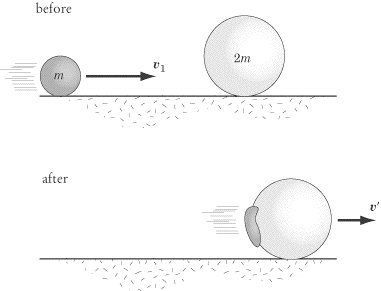
 , and the gumball of mass 2m is stationary. What is the final velocity,
  , of the gumball wad?
First, note that the gumball wad has a mass of m + 2m = 3m. The law of conservation of momentum tells us that  , and so
  . Therefore, the final gumball wad moves in the same direction as the first gumball, but with one-third of its velocity.
, and so . Therefore, the final gumball wad moves in the same direction as the first gumball, but with one-third of its velocity. Collisions in Two Dimensions
Two-dimensional collisions, while a little more involved than the one-dimensional examples we’ve looked at so far, can be treated in exactly the same way as their one-dimensional counterparts. Momentum is still conserved, as is kinetic energy in the case of elastic collisions. The significant difference is that you will have to break the trajectories of objects down into x- and y-components. You will then be able to deal with the two components separately: momentum is conserved in the x direction, and momentum is conserved in the y direction. Solving a problem of two-dimensional collision is effectively the same thing as solving two problems of one-dimensional collision.
Because SAT II Physics generally steers clear of making you do too much math, it’s unlikely that you’ll be faced with a problem where you need to calculate the final velocities of two objects that collide two-dimensionally. However, questions that test your understanding of two-dimensional collisions qualitatively are perfectly fair game.
Example

| ||||||

The correct answer choice is D, because momentum is not conserved in any of the other figures. Note that the initial momentum in the y direction is zero, so the momentum of the balls in the y direction after the collision must also be zero. This is only true for choices D and E. We also know that the initial momentum in the x direction is positive, so the final momentum in the x direction must also be positive, which is not true for E.


 , we could equally well express Newton’s Second Law as
  . Substituting
 , tells us that if the net force acting on a system is zero, then the impulse, and hence the change in momentum, is zero. Because the net force between the objects
  , is not the same as its final momentum,
  , and the initial momentum of the eight ball,
  , is not the same as its final momentum,
  , the initial momentum of the two balls combined is equal to the final momentum of the two balls combined:

 .
.  . Therefore,
  . Equating
  and
and